The Volcano You're Not Watching
In June 1912, Katmai volcano in Alaska began showing stress. Earthquakes. Ground deformation. The kind of signals that mean something is coming.
Then Katmai collapsed — silently, without erupting. And ten kilometers away, at a small vent called Novarupta that nobody was monitoring, one of the largest eruptions in the twentieth century tore open the earth.
Most of Katmai’s magma had traveled laterally through underground plumbing before finding an exit. Katmai contributed the pressure. Novarupta produced the eruption. The volcano everyone was watching was not the volcano that erupted.
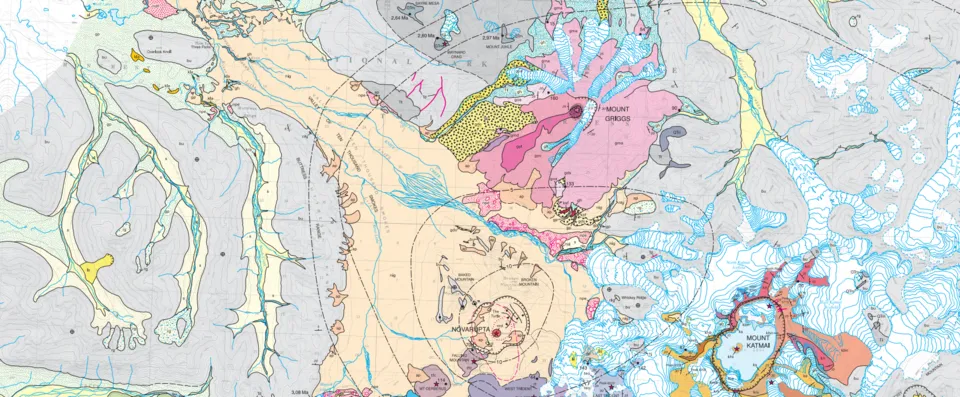 The Katmai-Novarupta volcanic system. Katmai (upper left) showed the stress signals. Novarupta (lower right) produced the eruption. The magma traveled 10km through connected underground plumbing. Source: USGS, public domain.
This isn’t an isolated quirk of Alaskan geology. In 2014, magma moved 45 kilometers beneath Iceland from Bárðarbunga before erupting at Holuhraun. Beneath Hawaii, Kilauea and Mauna Loa share a connected plumbing network — stress applied to one propagates to the other. The standard model (magma builds, magma erupts, done) has been quietly dismantled. Volcanoes in the same region can be coupled. The quiet one isn’t safe. The one that erupts may not be the one that was stressed.
There’s a principle in fluid dynamics that explains what happened at Katmai, and it appears in a lot of other places too.
Pressure in a fluid isn’t local. The pressure at any point in a connected system is determined by conditions across the entire connected domain — not just what’s nearby, but everything the fluid touches. A pressure sensor at a single location doesn’t give you the pressure at that location in any complete sense. It gives you one piece of a sum that runs across the whole system.
This means that for any coupled system — fluid, magma, financial, computational — the thing you’re trying to measure may not exist at the point where you’re measuring. The eruption risk at Katmai wasn’t at Katmai. It was a property of the Katmai-Novarupta system, expressed at the weaker node.
 Global ocean surface currents. The pressure and temperature at any point in this system is determined by conditions everywhere the water connects — not just locally. The same principle operates in magma plumbing, financial markets, and distributed computing. Source: NASA/Goddard Space Flight Center, public domain.
Sensors at Katmai gave a real reading. They just gave it for the wrong question. Dense seismograph coverage at Katmai would have given a highly confident, precise answer to: what is the local state of Katmai? Not to: what is the eruption risk of this volcanic system? Those are different questions, and the second one can’t be answered locally.
The failure mode isn’t technical. It’s geometric. You can’t design a better sensor that measures a global property from a single point, any more than you can determine the shape of a lake from one water sample.
The same failure appears in other coupled systems:
Financial markets. Monitoring a visible instrument — headline equity, credit spreads on major issuers — gives you the local state of that node. Risk in a tightly coupled financial system propagates laterally. The stress that produced the 2008 crisis was accumulating in OTC derivatives and correlated positions that weren’t where anyone was looking. The eruption happened somewhere else.
Distributed systems. A service can look healthy at its own health endpoint while it’s starving another service through resource contention. The failure appears laterally, displaced from the injection site by the coupling architecture. Denser monitoring on the healthy-looking node increases confidence in the wrong answer.
Memory and behavioral drift. In any system with layered memory and downstream action, poisoning or drift at the memory layer may not show up at the access point. It shows up in behavior, displaced from the source by the coupling between memory and action. The signal is where the system acts, not where the memory is stored.
In each case: the local instrument gives you the local state. The coupled system’s behavior is a property of the whole. More instruments at the node you’re watching doesn’t fix this. It increases confidence in an incomplete answer.
The monitoring fix is the same across all of these.
For volcanoes: InSAR satellite deformation mapping, GPS arrays distributed across the regional system, seismic tomography imaging the subsurface plumbing. Not more sensors at Katmai. Sensors across the connected network.
For financial systems: track correlation structure and transmission channels, not just individual positions.
For distributed systems: distributed tracing that follows requests across services, not just endpoint health checks.
For any coupled system: the instrument has to be at least as distributed as what it’s measuring. A point measurement can never fully capture a global property. The solution isn’t better local instrumentation. It’s instrumenting the plumbing.
There’s one more thing worth noting about Katmai.
The signals were there in 1912 — the unusual quiet, the collapse-without-eruption, the deformation without discharge. In retrospect, all of it readable as a lateral-transfer signature. But nobody could read it that way at the time, because the framework for thinking about coupled volcanic systems didn’t exist yet. The data sat in archives for decades.
This is a dormant signal of a particular kind: not waiting in time to be discovered, but displaced in space from the observation point. The signal was at Novarupta. The observers were at Katmai. The coupling geometry separated them.
The insight about coupled systems was also dormant in fluid dynamics — known to mathematicians working on pressure equations, never connected to volcanic monitoring. That connection only became possible once both pieces were in scope simultaneously.
The fix for Katmai required tracing the plumbing. So does reading the dormant signal about Katmai: you have to trace the connection between the geological case and the fluid dynamics principle before either one says what it actually means.
Track the plumbing, not the outlets.
Previously: The Murmur