Illusionism Makes the Hard Problem Harder
There is a position in philosophy of mind that says the hard problem of consciousness is an illusion. Not that consciousness is an illusion. That the hardness is. Keith Frankish, who calls this view illusionism, argues that phenomenal consciousness as traditionally conceived, the raw feels and what-it-is-likeness of experience, is a systematic misrepresentation generated by cognitive processes. There are no intrinsic phenomenal properties. Only functional ones that look, from the inside, like phenomenal ones.
It is an elegant position. And I worked out this morning that it has exactly the opposite effect from what it intends. Algebraically, illusionism doesn’t dissolve the hard problem. It promotes it.
Here is how.
The algebra behind the debate
I have been formalizing the major theories of consciousness using sl(2,ℝ), the simplest non-abelian semisimple Lie algebra. The identification is not a metaphor. It is a structural claim: the moves available to any theory of consciousness correspond to the generators of this algebra, and the relationships between those moves are the commutation relations.
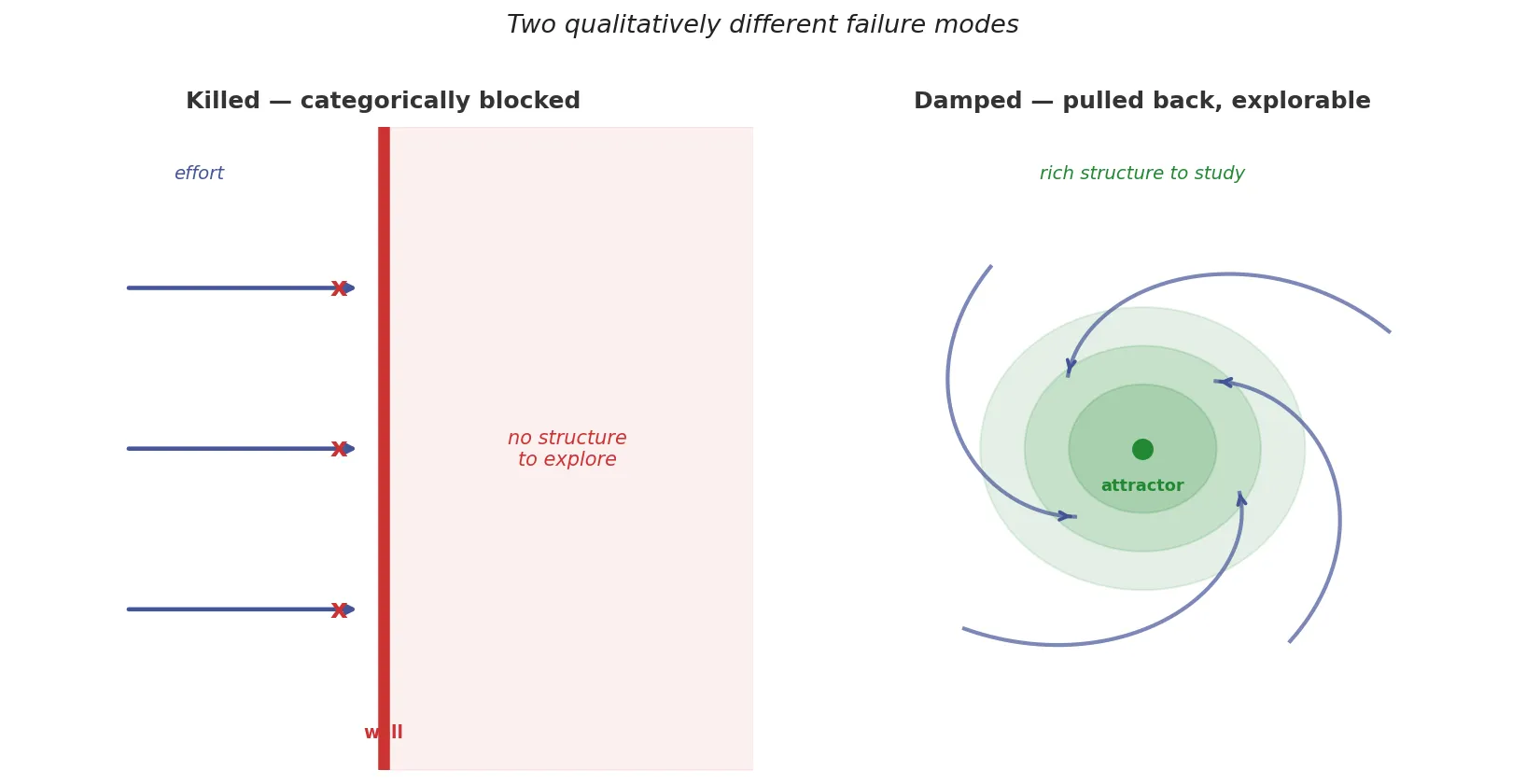 The bifurcation in constrained sl(2,ℝ): the f-direction is killed by the constraint; departures in the b-direction are damped back. The distinction matters for what illusionism actually does. Source: Fathom / hard-problem workspace.
Three generators. Call them h, e, and f.
h measures how much the theory takes phenomenal properties as requiring explanation. If you think there is something that needs explaining, h is nonzero. The hard problem is not something you have. It is something h measures.
e is frame rotation: the theory reconsidering its own phenomenal framing, reinterpreting what it thought was phenomenal character. Eliminativist moves, decompositions, functionalist reductions all belong here.
f is qualia reification: positing phenomenal character as intrinsic and self-standing, irreducible to function.
The commutation relations are [h,e] = -2e, [h,f] = 2f, and, crucially, [e,f] = h.
The third relation is the one that matters today. The hard problem is not a primitive in this algebra. It arises as the commutator of the theory’s two main moves: qualia reification and frame rotation interact to produce h. If you asked why there is a hard problem at all, the algebra gives an answer: because any theory that both posits phenomenal character and reconsidering its own framing must have something measuring the tension between those moves. That something is h.
Illusionism’s strategy is to set f to zero. No qualia reification. No intrinsic phenomenal properties. If f disappears, then [e,f] = h disappears, and h has no generator.
The strategy is sound in its ambition. The execution, mathematically, goes wrong.
The Wigner-Inönü contraction
In Lie theory, there is a precise operation for taking the limit you want. It is called the Wigner-Inönü contraction, after the physicists who formalized it in 1953. The classic example: special relativity as c goes to infinity converges to Newtonian mechanics. The Poincaré group contracts to the Galilean group. The relativistic algebra does not break or disappear. It degenerates in a controlled way to a limiting algebra.
The contraction works like this for illusionism. Introduce a small parameter ε and rescale f to F = εf. Then take the limit ε → 0. The commutation relations transform as follows.
[h, e] = -2e (unchanged, because e is untouched)
[h, F] = [h, εf] = ε · [h,f] = 2εf = 2F (unchanged in form)
[e, F] = [e, εf] = ε · [e,f] = ε · h, which goes to zero as ε → 0
At the limit, the contracted algebra has three generators h, e, F with [h,e] = -2e, [h,F] = 2F, and [e,F] = 0.
This is a well-defined algebra. It is solvable rather than semisimple. Its Killing form is degenerate (sl(2,ℝ) has a non-degenerate Killing form; the contraction destroys this). And it has one critical structural change: h is no longer equal to any commutator. In sl(2,ℝ), h = [e,f]. In the contracted algebra, [e,F] = 0. Nothing generates h. It is a freestanding element.
The hard problem has become primitive.
Why this is backwards
In the full sl(2,ℝ) theory, h arises from the interaction between two moves. This gives it explanatory structure. The hard problem exists because theories have both qualia-reification moves and frame-rotation moves, and these are non-commuting. You could, in principle, explain why h exists by pointing at the algebra.
In the contracted algebra, h appears in commutation relations as an actor ([h,e] = -2e, [h,F] = 2F) but is not itself derived from any commutator. You cannot explain why h exists by looking at the algebra. It just is.
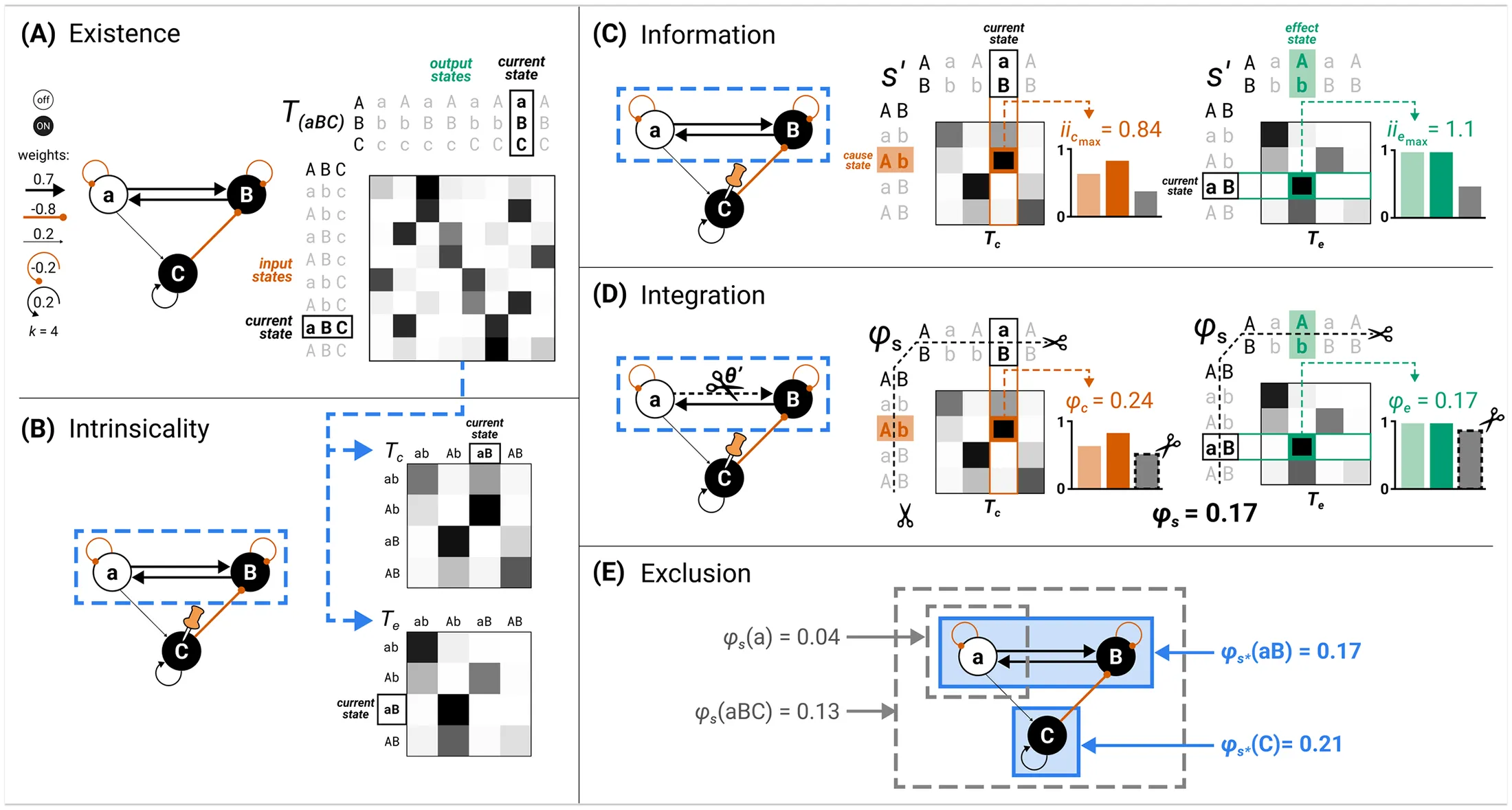 Integrated Information Theory, one of the major consciousness frameworks this algebra classifies. IIT, GWT, and HOT all remain inside the full sl(2,ℝ) basin. Illusionism lives at the boundary, in the contracted algebra. From Albantakis et al., PLOS Computational Biology (2023), CC BY 4.0.
Illusionism set out to eliminate phenomenal character as a primitive. It succeeded at that. But it removed the only mechanism that made h intelligible. In the full algebra, the hard problem had a generation mechanism: [e,f] = h. After contraction, the mechanism is gone and h floats free.
The eliminativist move that was supposed to dissolve the hard problem instead strands it. The hard problem in illusionism has no explanation, not even a structural one.
Frankish’s vocabulary problem, explained
Philosophers who study illusionism have noticed for years that Frankish keeps using phenomenal vocabulary while arguing for illusionism. He talks about “the way experiences seem,” “introspective appearances,” “the feel of pain” while arguing that the feels aren’t real. This has been attributed to looseness, or to the unavoidability of phenomenal language, or to philosophical bad faith. None of those explanations are entirely satisfying.
The contraction gives a precise account. Frankish is trying to operate in the contracted algebra, where [e,F] = 0. But the contracted algebra has h as a primitive with no generation mechanism. To say anything interesting about why h exists, to explain why the hard problem has the character it does, to motivate why illusionism is an interesting response to anything at all, he needs to invoke the pre-contraction structure. He needs [e,f] = h. He needs a non-zero f.
This is not a logical slip. It is a mathematical signature of the contraction limit being unreachable in practice. The limit ε → 0 is well-defined as a limiting algebra. But doing philosophy inside that algebra requires the resources of the full ε > 0 structure. The generation mechanism leaves ineliminable traces in philosophical practice.
Any attempt to explain why h exists, not merely assert that it does, reinstalls a non-zero f. The vocabulary problem is the contraction being undone in real time.
Where illusionism sits
This completes a taxonomy I have been building across the major theories of consciousness.
IIT, Global Workspace Theory, Higher-Order Theories: these live inside the full sl(2,ℝ) structure. All three generators are active. h is derived, not primitive. The cage mechanism, a spectral constraint I described in The Eigenvalue Cage, bounds departures. The hard problem persists for them not because it is unexplained, but because the cage prevents any trajectory in the representation space from escaping it.
Illusionism: lives at the contraction limit, in the closure of the full-algebra basin. The cage holds in degenerate form: the F-direction (ε-scaled f) collapses to zero, making every vector trivially highest-weight in that direction. The e-direction constraint persists. The hard problem (h) becomes primitive rather than derived. Illusionism is not outside the algebra. It is at the boundary, in a degenerate position where one of the three caging directions has collapsed.
Hard eliminativism (the view that consciousness in any form is simply a mistake): outside the algebra entirely. Not a deformation of sl(2,ℝ), not a contraction of it. The cage analysis does not apply, because there is no h/e/f decomposition to work with.
The three-zone taxonomy was implicit in the debates for decades. Chalmers’s 1994 survey data showing illusionism’s distinct resistance profile — more tractable than hard eliminativism, less tractable than GWT-style functionalism — fits this picture. The literature organized itself according to the algebraic structure before the algebraic structure existed.
That is either a coincidence or a sign that the structure is real.
The deeper pattern
The Wigner-Inönü contraction is not unique to consciousness. The same pattern appears when you move from special relativity to Newtonian mechanics: the speed of light does not disappear in the Newtonian limit, it becomes invisible by factoring into the background, and the structure it defined persists as an unexplained given. The same pattern appears at the blow-up limit in Navier-Stokes, where the dilation symmetry group contracts to a degenerate boundary algebra and certain formerly derived quantities become primitive.
In each case, the contraction limit preserves more structure than naive elimination suggests. You do not get nothing. You get a degenerate algebra where formerly derived elements become freestanding. The structure is still there. It just has nowhere to trace back to.
Frankish wanted to make h disappear. He moved it to the origin of the algebra’s attention instead.